 Weather
 Locations
 Careers
 Login
Login


Forest product updates
Weak fiber markets are an increasing challenge.
Forest products markets were mixed through August, with domestic lumber demand relatively stable but fiber markets facing significant challenges. While the housing market continues to face affordability headwinds and has moved past peak season sales activity, lower lumber production has resulted in stronger prices and mill profitability. Fiber markets have become a significant challenge to the industry, with the prolonged Nippon Dynawave pulp mill shutdown in Longview, WA; additional British Columbia pulp mill curtailments; and reduced chip consumption creating excess chip inventories and fewer outlets for pulp logs throughout the Pacific Northwest. The Trump Administration imposed 50% tariffs on various Canadian products related to plywood, veneer, wood furniture, semi-processed and raw wood inputs, and wood-derived paper and pulp products. This policy went into effect August 28 and will increase costs and uncertainty within the U.S., particularly for end users and processors.
Northwest log markets remained generally stable through August. Mill demand is reportedly steady, particularly for high-quality logs, despite strong inventory levels. Exports fell for the third month in a row in July, reflecting weakening international demand. Wildfire activity across Oregon, Washington, and Idaho has disrupted harvesting activity and may eventually lead to increased salvage volumes (logs harvested from sites damaged by wildfires). Forisk recently estimated that longer-term timber fundamentals remain supported by expectations for a tighter coastal Oregon timber supply, as harvest restrictions associated with the Oregon Private Forest Accord, wildfire-related losses, and age-class dynamics are expected to reduce harvestable inventory over the next decade. On the policy front, a Washington court postponed implementation of the expanded non-fish-bearing stream-buffer rule pending appeal by the Washington Forest Protection Association and Washington Farm Forestry Association. USDA proposed rescinding the 2001 Roadless Rule, which currently restricts road construction and timber harvesting on about 4 million acres of National Forest System lands. This policy change is intended to empower local agency decision making within the Forest Service in order to support management practices that improve forest health.
Profitability
September 16, 2026Forest product mills: Slightly profitable - Neutral 12-month outlook
Timberlands: Slightly profitable - Neutral 12-month outlook
Stable lumber demand along with falling domestic production and Canadian imports are supporting slightly profitable conditions.
Despite strong log inventories, mill demand in the Northwest remains steady and supportive of prices.
The U.S. housing market is the primary driver of forest products demand. Log and lumber exports play a relatively minor role, making up about 6% and 3% of total domestic production, respectively. On the West Coast, log producers have historically benefited from strong Japanese demand for high-quality grades. Following the Great Recession, demand from China increased significantly to support housing construction. These trends are reversing due to aging demographics and weakening economies. The Softwood Lumber Agreement sets the terms for Canadian lumber exports to the U.S., which make up about a quarter of total domestic supply.
Log production, exports and imports
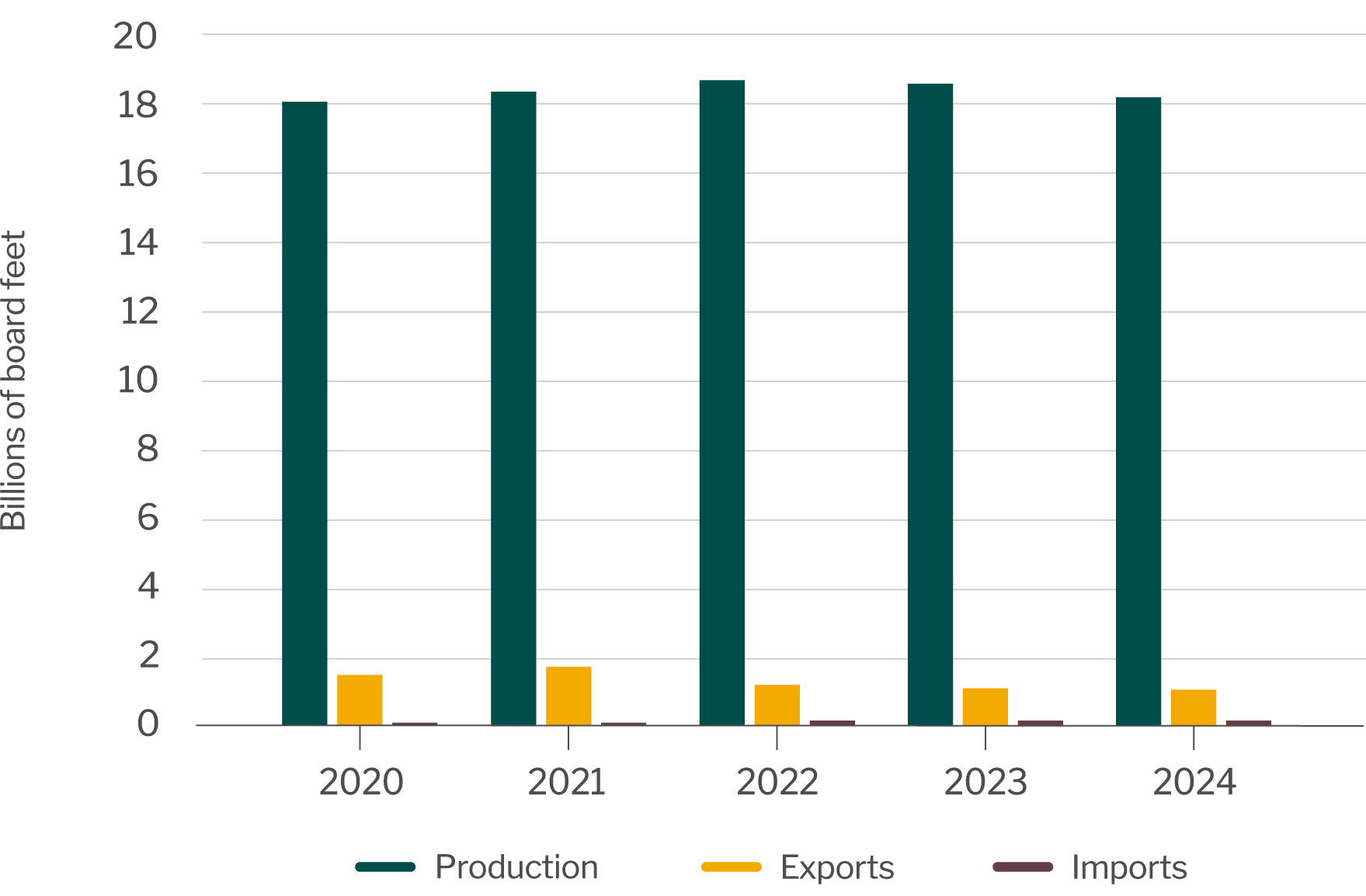
Forisk. U.S. Census Bureau. Production levels were calculated using region specific recovery rates. Trade data was converted using .22 thousand board feet per cubic meter.
Lumber production, exports and imports
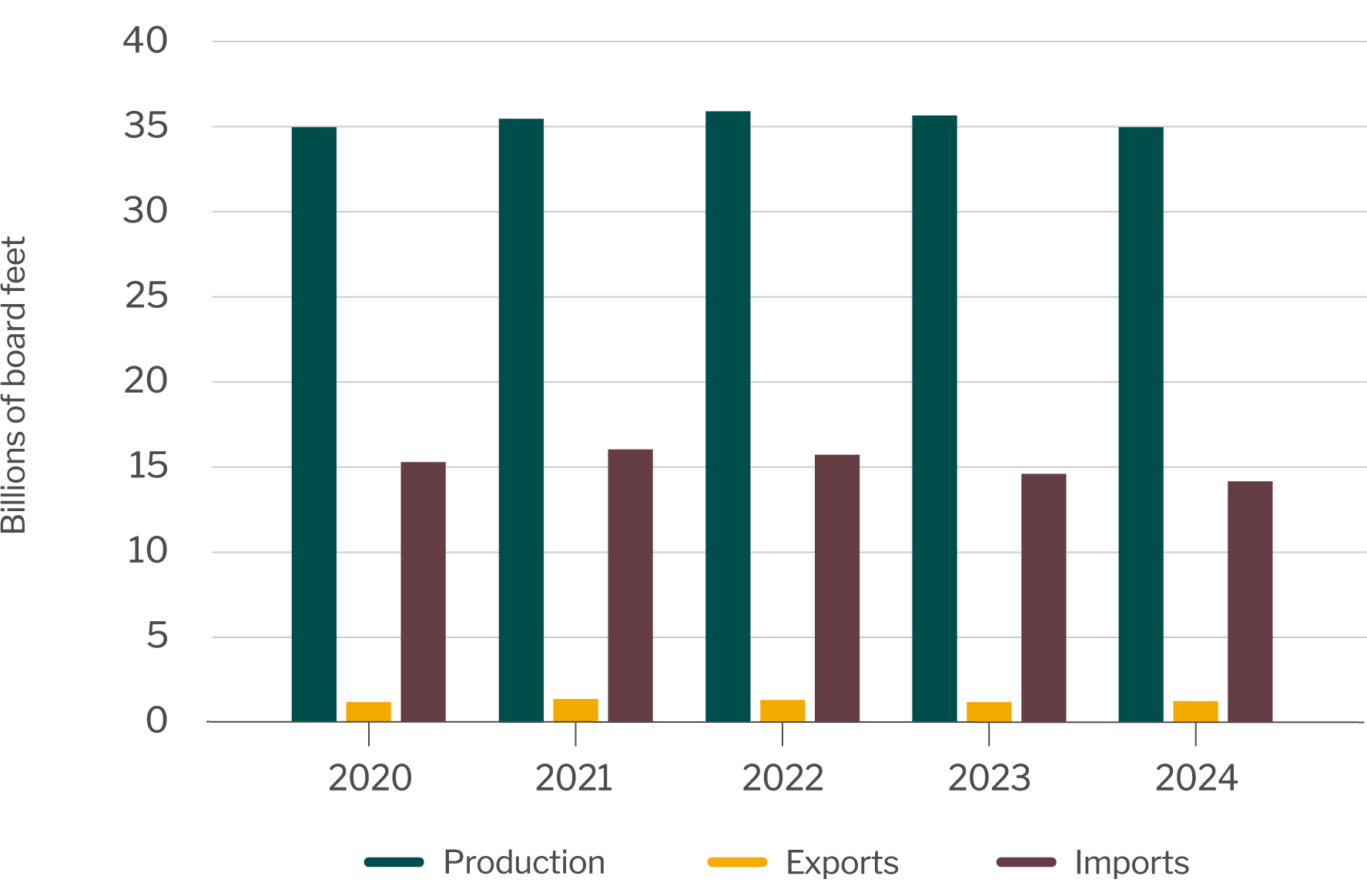
Forisk. U.S. Census Bureau. Trade data was converted using .452 thousand board feet per cubic meter.
Tariff tracker - Tariff rates applied to U.S. trade partners are consistenly updated to reflect policy changes. The World Trade Organization (WTO) tracks duties and tariffs on forest products. For your convenience, the following links will take you to tariff data for top markets, including Japan and Vietnam. Logs are currently exempt from tariffs for Canada under the United States-Mexico-Canada Agreement (USMCA), but please refer to the U.S. Trade Representative website for up-to-date information. The U.S. applies countervailing duties on Canadian lumber imports based on an annual review process (detailed information can be found at the Federal Register). Please consult with a trade lawyer or professional for detailed and up-to-date insights on tariff rates and their application to forest products.
For guidance on interpreting duty and tariff rates, please refer to our Tariff Guide.
Forest product updates
Weak fiber markets are an increasing challenge.
Forest products markets were mixed through August, with domestic lumber demand relatively stable but fiber markets facing significant challenges. While the housing market continues to face affordability headwinds and has moved past peak season sales activity, lower lumber production has resulted in stronger prices and mill profitability. Fiber markets have become a significant challenge to the industry, with the prolonged Nippon Dynawave pulp mill shutdown in Longview, WA; additional British Columbia pulp mill curtailments; and reduced chip consumption creating excess chip inventories and fewer outlets for pulp logs throughout the Pacific Northwest. The Trump Administration imposed 50% tariffs on various Canadian products related to plywood, veneer, wood furniture, semi-processed and raw wood inputs, and wood-derived paper and pulp products. This policy went into effect August 28 and will increase costs and uncertainty within the U.S., particularly for end users and processors.
Northwest log markets remained generally stable through August. Mill demand is reportedly steady, particularly for high-quality logs, despite strong inventory levels. Exports fell for the third month in a row in July, reflecting weakening international demand. Wildfire activity across Oregon, Washington, and Idaho has disrupted harvesting activity and may eventually lead to increased salvage volumes (logs harvested from sites damaged by wildfires). Forisk recently estimated that longer-term timber fundamentals remain supported by expectations for a tighter coastal Oregon timber supply, as harvest restrictions associated with the Oregon Private Forest Accord, wildfire-related losses, and age-class dynamics are expected to reduce harvestable inventory over the next decade. On the policy front, a Washington court postponed implementation of the expanded non-fish-bearing stream-buffer rule pending appeal by the Washington Forest Protection Association and Washington Farm Forestry Association. USDA proposed rescinding the 2001 Roadless Rule, which currently restricts road construction and timber harvesting on about 4 million acres of National Forest System lands. This policy change is intended to empower local agency decision making within the Forest Service in order to support management practices that improve forest health.

Profitability
September 16, 2026Forest product mills: Slightly profitable - Neutral 12-month outlook
Timberlands: Slightly profitable - Neutral 12-month outlook
Stable lumber demand along with falling domestic production and Canadian imports are supporting slightly profitable conditions.
Despite strong log inventories, mill demand in the Northwest remains steady and supportive of prices.
The U.S. housing market is the primary driver of forest products demand. Log and lumber exports play a relatively minor role, making up about 6% and 3% of total domestic production, respectively. On the West Coast, log producers have historically benefited from strong Japanese demand for high-quality grades. Following the Great Recession, demand from China increased significantly to support housing construction. These trends are reversing due to aging demographics and weakening economies. The Softwood Lumber Agreement sets the terms for Canadian lumber exports to the U.S., which make up about a quarter of total domestic supply.
Log production, exports and imports
Forisk. U.S. Census Bureau. Production levels were calculated using region specific recovery rates. Trade data was converted using .22 thousand board feet per cubic meter.
Lumber production, exports and imports
Forisk. U.S. Census Bureau. Trade data was converted using .452 thousand board feet per cubic meter.
Tariff tracker - Tariff rates applied to U.S. trade partners are consistenly updated to reflect policy changes. The World Trade Organization (WTO) tracks duties and tariffs on forest products. For your convenience, the following links will take you to tariff data for top markets, including Japan and Vietnam. Logs are currently exempt from tariffs for Canada under the United States-Mexico-Canada Agreement (USMCA), but please refer to the U.S. Trade Representative website for up-to-date information. The U.S. applies countervailing duties on Canadian lumber imports based on an annual review process (detailed information can be found at the Federal Register). Please consult with a trade lawyer or professional for detailed and up-to-date insights on tariff rates and their application to forest products.
For guidance on interpreting duty and tariff rates, please refer to our Tariff Guide.
IN THIS SECTION


Forest Products Industry Perspective
View the latest AgWest Forest Products Industry Perspective
Learn more