Weather
 Locations
 Careers
 Login
Login


Potato updates
After years of surplus, potato markets begin to rebalance.
After several years of abundant production and weaker demand, Pacific Northwest potato growers are finally seeing signs of a smaller crop in 2026. Weather-related production challenges, including water shortages, heat stress, and localized frost concerns, are reducing yields and helping bring supply closer in line with demand. While lower production presents challenges for growers, many producers view the smaller crop as a welcome development that could improve market balance and support stronger pricing throughout the marketing year.
In Idaho, the Snake River reservoir system was reported at just 19% of capacity, resulting in significant use of prevented planting insurance and reduced irrigation availability across parts of the state. Water shortages, combined with heat and wind stress, have reduced yield potential, with growers noting that some Norkotah potatoes died early in the season due to poor weather conditions. Burbank yields have also come below expectations. Despite lower production, potato quality remains favorable, particularly for Clearwater and Ivory varieties.
In Washington, potato market fundamentals continue to improve as stronger fresh demand and a smaller crop help bring supply and demand into better balance. Fresh potato prices have strengthened, with growers reporting returns of approximately $10 to $11 per cwt. While early-planted potatoes generally produced favorable results, some later-planted fields experienced stress and declining yield potential by late August. Even with these localized production challenges, processors continue moving aggressively through contracted acreage, and growers do not expect the surplus potato conditions that have pressured markets in recent years.
In Oregon's Klamath Basin, market conditions remain relatively stable. Water availability remains a concern in the region, with some acreage taken out of production earlier this year due to water concerns.
Profitability
September 16, 2026Potatoes (contracted): Slightly profitable - Neutral 12-month outlook
Potatoes (uncontracted): Slightly unprofitable - Bullish 12-month outlook
Contracted potatoes are expected to remain slightly profitable as processor contracts provide stable pricing. Water shortages may result in a smaller crop.
Uncontracted potatoes remain slightly unprofitable as elevated input costs continue to pressure margins, although improving supply-demand balance and a smaller regional crop are expected to support stronger market prices moving forward.
The U.S. is the third-largest exporter of potatoes globally, followed by the European Union and Canada. Potato exports are generally categorized into five types: fresh, dehydrated, frozen, seed and chips. By value, frozen potatoes, most commonly in the form of french fries, make up the largest export category. The primary export destinations for U.S. potato products are Mexico, Japan, Canada and South Korea, which together account for 72% of all exports. Despite this, the U.S. imports more potatoes than it exports. This trade imbalance is typical for vegetables, as the U.S. often runs a trade deficit in most vegetable categories. Most imported potato products are sent to areas in the U.S. with limited potato production or consist of raw potatoes from Canada destined for U.S. processing plants.
Potato production, exports and imports
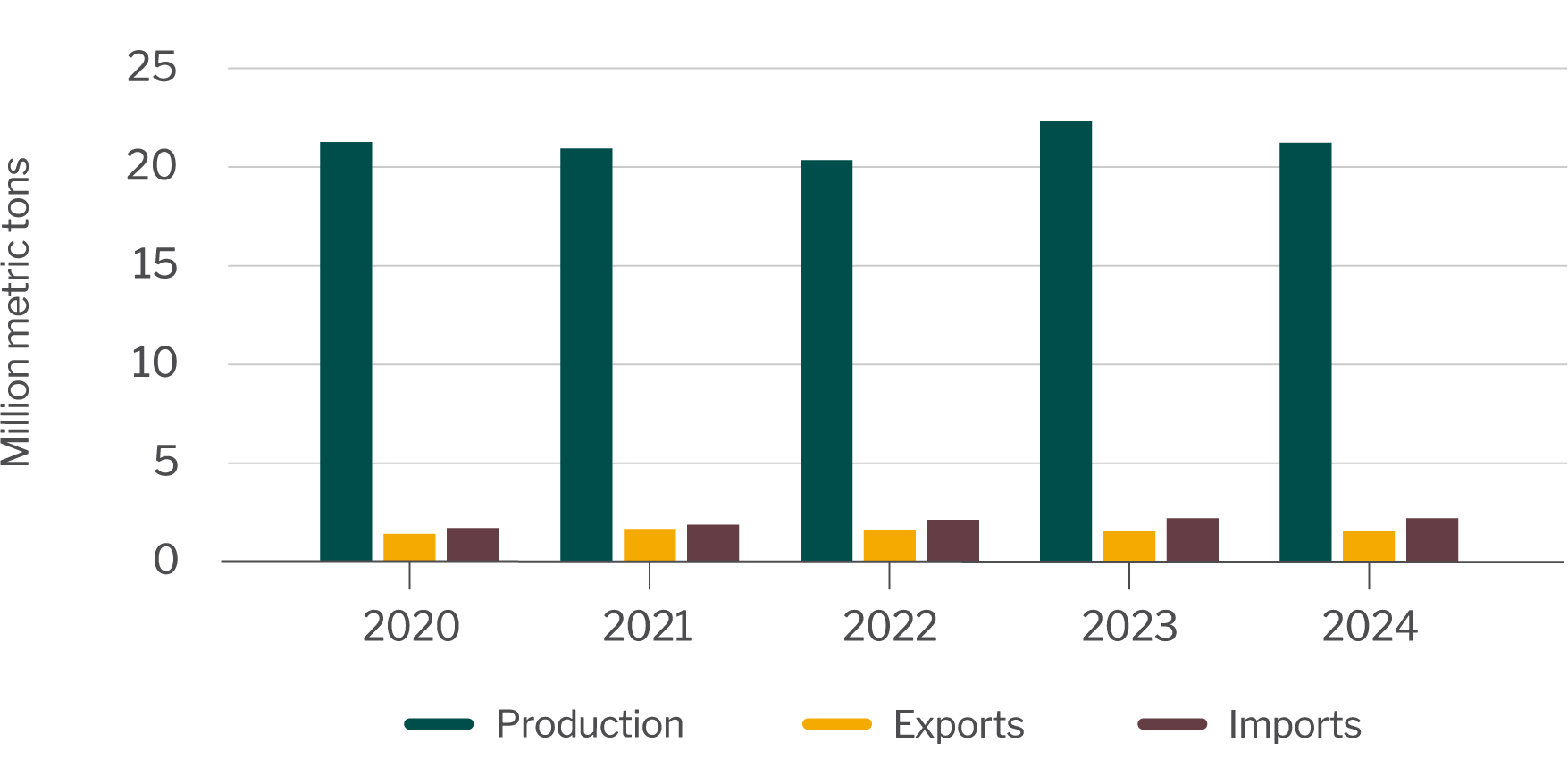
Source: USDA National Agriculture Statistics Service. U.S. Census Bureau.
Tariff tracker - Tariff rates applied to U.S. trade partners are consistenly updated to reflect policy changes. The World Trade Organization (WTO) tracks duties and tariffs on potato products. For your convenience, the following links will take you to tariff data on prepared, preserved, or frozen potato products (a leading U.S. export for the potato industry) for top markets including Japan and South Korea. Potato products are currently exempt from tariffs with Mexico and Canada under the United States-Mexico-Canada Agreement (USMCA), but please refer to the U.S. Trade Representative website for up-to-date information. WTO also tracks rates for potato imports to the U.S. Please consult with a trade lawyer or professional for detailed and up-to-date insights on tariff rates and their application to potatoes.
For guidance on interpreting duty and tariff rates, please refer to our Tariff Guide.
Potato updates
After years of surplus, potato markets begin to rebalance.
After several years of abundant production and weaker demand, Pacific Northwest potato growers are finally seeing signs of a smaller crop in 2026. Weather-related production challenges, including water shortages, heat stress, and localized frost concerns, are reducing yields and helping bring supply closer in line with demand. While lower production presents challenges for growers, many producers view the smaller crop as a welcome development that could improve market balance and support stronger pricing throughout the marketing year.
In Idaho, the Snake River reservoir system was reported at just 19% of capacity, resulting in significant use of prevented planting insurance and reduced irrigation availability across parts of the state. Water shortages, combined with heat and wind stress, have reduced yield potential, with growers noting that some Norkotah potatoes died early in the season due to poor weather conditions. Burbank yields have also come below expectations. Despite lower production, potato quality remains favorable, particularly for Clearwater and Ivory varieties.
In Washington, potato market fundamentals continue to improve as stronger fresh demand and a smaller crop help bring supply and demand into better balance. Fresh potato prices have strengthened, with growers reporting returns of approximately $10 to $11 per cwt. While early-planted potatoes generally produced favorable results, some later-planted fields experienced stress and declining yield potential by late August. Even with these localized production challenges, processors continue moving aggressively through contracted acreage, and growers do not expect the surplus potato conditions that have pressured markets in recent years.
In Oregon's Klamath Basin, market conditions remain relatively stable. Water availability remains a concern in the region, with some acreage taken out of production earlier this year due to water concerns.

Profitability
September 16, 2026Potatoes (contracted): Slightly profitable - Neutral 12-month outlook
Potatoes (uncontracted): Slightly unprofitable - Bullish 12-month outlook
Contracted potatoes are expected to remain slightly profitable as processor contracts provide stable pricing. Water shortages may result in a smaller crop.
Uncontracted potatoes remain slightly unprofitable as elevated input costs continue to pressure margins, although improving supply-demand balance and a smaller regional crop are expected to support stronger market prices moving forward.
The U.S. is the third-largest exporter of potatoes globally, followed by the European Union and Canada. Potato exports are generally categorized into five types: fresh, dehydrated, frozen, seed and chips. By value, frozen potatoes, most commonly in the form of french fries, make up the largest export category. The primary export destinations for U.S. potato products are Mexico, Japan, Canada and South Korea, which together account for 72% of all exports. Despite this, the U.S. imports more potatoes than it exports. This trade imbalance is typical for vegetables, as the U.S. often runs a trade deficit in most vegetable categories. Most imported potato products are sent to areas in the U.S. with limited potato production or consist of raw potatoes from Canada destined for U.S. processing plants.
Potato production, exports and imports
Source: USDA National Agriculture Statistics Service. U.S. Census Bureau.
Tariff tracker - Tariff rates applied to U.S. trade partners are consistenly updated to reflect policy changes. The World Trade Organization (WTO) tracks duties and tariffs on potato products. For your convenience, the following links will take you to tariff data on prepared, preserved, or frozen potato products (a leading U.S. export for the potato industry) for top markets including Japan and South Korea. Potato products are currently exempt from tariffs with Mexico and Canada under the United States-Mexico-Canada Agreement (USMCA), but please refer to the U.S. Trade Representative website for up-to-date information. WTO also tracks rates for potato imports to the U.S. Please consult with a trade lawyer or professional for detailed and up-to-date insights on tariff rates and their application to potatoes.
For guidance on interpreting duty and tariff rates, please refer to our Tariff Guide.