Weather
 Locations
 Careers
 Login
Login


Dairy updates
Dairy margins narrow as beef buffer fades.
Dairy producers across the West continue to navigate tight margins as softer milk prices and elevated input costs limit profitability. While many operations remain near breakeven or slightly profitable, financial performance varies significantly by region.
In 2025, profitability varied considerably across Western dairy regions. AgWest dairy customers in Western Washington averaged a loss of approximately $0.20 per cwt, reflecting high processing assessments and production costs. In contrast, Idaho and Arizona dairy producers averaged net earnings of more than $2.00 per cwt, while California producers generated average net income exceeding $4.00 per cwt. Much of this advantage was driven by strong non-milk revenue streams, particularly cattle sales. Historically high beef and calf prices provided valuable supplemental income, helping offset weak milk margins and support overall dairy profitability.
Conditions have shifted in 2026. In Washington, producer sentiment has improved following a significant reduction in milk assessment fees at a major regional processor, with average assessments declining from roughly $4.00 per cwt to $1.75 per cwt. At the same time, an important source of supplemental revenue has begun to weaken. Beef-cross calf prices remain historically strong but have declined approximately $300 to $400 per head from peak levels, while Holstein calf prices have fallen roughly $150 per head in recent months.
Looking ahead, dairy margins are expected to remain under pressure through the remainder of 2026. As cattle markets normalize and analysts suggest the industry may be approaching the later stages of the current cattle cycle, supplemental cattle revenue is expected to decline. Feed costs have increased as drought conditions support higher hay prices in parts of the West; grain markets have strengthened amid global supply concerns and the continued Russia-Ukraine conflict; and milk prices remain subdued. The All-Milk price fell to $19.35 per cwt in August and, while modest improvement is expected, prices are projected to remain below $21 per cwt through year-end. With both milk prices and cattle-related revenue expected to soften, dairy producers are preparing for tighter margins and increased financial pressure in the months ahead.
Profitability
September 16, 2026Dairy: Slightly profitable - Neutral 12-month outlook
Despite persistent pressure from low milk prices and elevated production costs, many dairy producers have maintained slight profitability due to strong supplemental income from cattle sales. As calf values retreat and feed costs rise, that profitability buffer is shrinking, creating a more challenging outlook.
The U.S. ranks as the second-largest exporter of dairy products, following the European Union. Over 15% of U.S. dairy production is exported. Mexico and Canada are the top destinations, accounting for more than 40% of total exports. Key U.S. dairy exports include nonfat dried milk, skim milk powder, cheese, whey, lactose, butter and other products. For cheese, major export markets include Mexico, South Korea, Japan and Canada.
The U.S. also imports a significant amount of cheese, primarily from the European Union. Many of these imported cheeses carry geographic indicators, signifying they originate from specific regions and are uniquely tied to those areas. This designation prevents others from replicating such cheeses outside their original region, ensuring their distinctiveness.
Cheese production, exports and imports
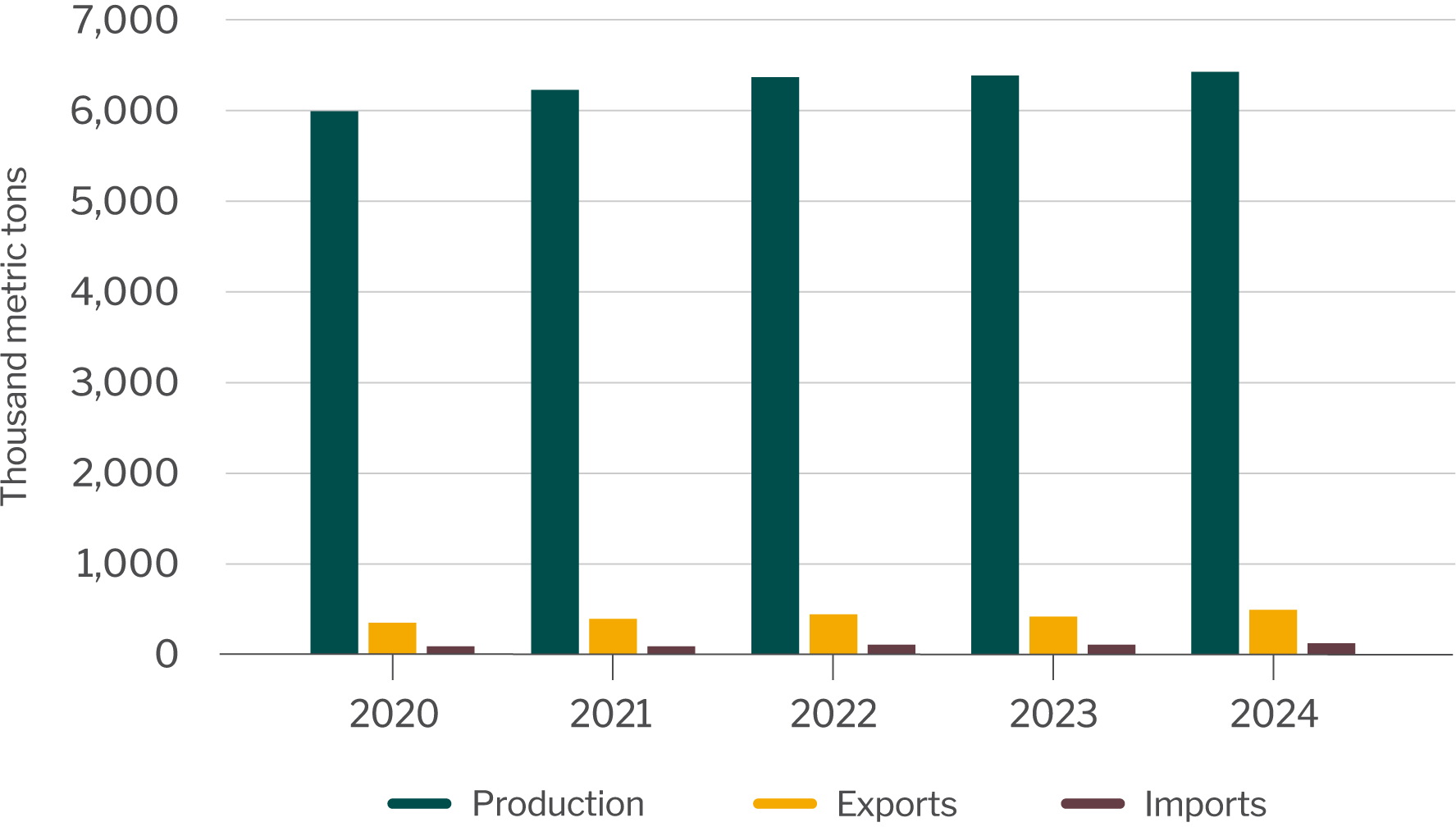
Source: USDA National Agriculture Statistics Service. U.S. Census Bureau.
Tariff tracker - Tariff rates applied to U.S. trade partners are consistenly updated to reflect policy changes. The World Trade Organization (WTO) tracks duties and tariffs on dairy products. For your convenience, the following links will take you to tariff data on cheddar cheese (a leading U.S. export for the dairy industry) for top markets including South Korea and Japan. Dairy products are currently exempt from tariffs for Mexico and Canada under the United States-Mexico-Canada Agreement (USMCA), but please refer to the U.S. Trade Representative website for up-to-date information. WTO also tracks rates for dairy imports to the U.S. Please consult with a trade lawyer or professional for detailed and up-to-date insights on tariff rates and their application to dairy products.
For guidance on interpreting duty and tariff rates, please refer to our Tariff Guide.
Dairy updates
Dairy margins narrow as beef buffer fades.
Dairy producers across the West continue to navigate tight margins as softer milk prices and elevated input costs limit profitability. While many operations remain near breakeven or slightly profitable, financial performance varies significantly by region.
In 2025, profitability varied considerably across Western dairy regions. AgWest dairy customers in Western Washington averaged a loss of approximately $0.20 per cwt, reflecting high processing assessments and production costs. In contrast, Idaho and Arizona dairy producers averaged net earnings of more than $2.00 per cwt, while California producers generated average net income exceeding $4.00 per cwt. Much of this advantage was driven by strong non-milk revenue streams, particularly cattle sales. Historically high beef and calf prices provided valuable supplemental income, helping offset weak milk margins and support overall dairy profitability.
Conditions have shifted in 2026. In Washington, producer sentiment has improved following a significant reduction in milk assessment fees at a major regional processor, with average assessments declining from roughly $4.00 per cwt to $1.75 per cwt. At the same time, an important source of supplemental revenue has begun to weaken. Beef-cross calf prices remain historically strong but have declined approximately $300 to $400 per head from peak levels, while Holstein calf prices have fallen roughly $150 per head in recent months.
Looking ahead, dairy margins are expected to remain under pressure through the remainder of 2026. As cattle markets normalize and analysts suggest the industry may be approaching the later stages of the current cattle cycle, supplemental cattle revenue is expected to decline. Feed costs have increased as drought conditions support higher hay prices in parts of the West; grain markets have strengthened amid global supply concerns and the continued Russia-Ukraine conflict; and milk prices remain subdued. The All-Milk price fell to $19.35 per cwt in August and, while modest improvement is expected, prices are projected to remain below $21 per cwt through year-end. With both milk prices and cattle-related revenue expected to soften, dairy producers are preparing for tighter margins and increased financial pressure in the months ahead.

Profitability
September 16, 2026Dairy: Slightly profitable - Neutral 12-month outlook
Despite persistent pressure from low milk prices and elevated production costs, many dairy producers have maintained slight profitability due to strong supplemental income from cattle sales. As calf values retreat and feed costs rise, that profitability buffer is shrinking, creating a more challenging outlook.
The U.S. ranks as the second-largest exporter of dairy products, following the European Union. Over 15% of U.S. dairy production is exported. Mexico and Canada are the top destinations, accounting for more than 40% of total exports. Key U.S. dairy exports include nonfat dried milk, skim milk powder, cheese, whey, lactose, butter and other products. For cheese, major export markets include Mexico, South Korea, Japan and Canada.
The U.S. also imports a significant amount of cheese, primarily from the European Union. Many of these imported cheeses carry geographic indicators, signifying they originate from specific regions and are uniquely tied to those areas. This designation prevents others from replicating such cheeses outside their original region, ensuring their distinctiveness.
Cheese production, exports and imports
Source: USDA National Agriculture Statistics Service. U.S. Census Bureau.
Tariff tracker - Tariff rates applied to U.S. trade partners are consistenly updated to reflect policy changes. The World Trade Organization (WTO) tracks duties and tariffs on dairy products. For your convenience, the following links will take you to tariff data on cheddar cheese (a leading U.S. export for the dairy industry) for top markets including South Korea and Japan. Dairy products are currently exempt from tariffs for Mexico and Canada under the United States-Mexico-Canada Agreement (USMCA), but please refer to the U.S. Trade Representative website for up-to-date information. WTO also tracks rates for dairy imports to the U.S. Please consult with a trade lawyer or professional for detailed and up-to-date insights on tariff rates and their application to dairy products.
For guidance on interpreting duty and tariff rates, please refer to our Tariff Guide.