Weather
 Locations
 Careers
 Login
Login


Cattle updates
Prices recede, but cattle fundamentals remain.
Cattle markets softened during August after reaching record highs earlier this summer. Recent policy developments coupled with a rebound in hay market prices have tempered producer optimism. Producers who marketed cattle earlier or locked in contracts at peak prices continue to benefit from historically strong margins, while those still holding cattle have seen prices ease. Fed cattle markets have softened since July. Calf values have also retreated by 15% from midsummer peaks, although they remain among the highest levels producers have ever received. Despite the recent correction, fundamentals remain supportive as cattle inventories stay historically tight and beef demand continues to hold up remarkably well, even with retail beef prices at record levels.
Feed and forage concerns are becoming a larger focus as producers plan for fall and winter. Across much of the West, deteriorating pasture conditions and earlier-than-normal range removal are forcing some operations to begin supplemental feeding sooner than usual. As of August 31, 59% of Arizona, 46% of Idaho, 55% of Montana, and 39% of Oregon pasture and rangeland was rated poor to very poor. At the same time, strengthening hay prices are increasing winter feed costs. Some producers were able to receive disaster assistance payments of $36 to $38 per head, which has helped offset a portion of rising feed and transportation expenses.
Processing capacity remains a concern for many cattle producers. Tyson Foods announced in August that it is seeking a buyer for its Wallula, Washington, beef processing facility. While the plant is expected to continue operating under new ownership, the announcement highlights broader industry concerns about long-term packing capacity and its potential impact on future herd expansion. At the same time, producers are closely monitoring recent federal policy developments. A September 4 executive order calls for reviews of federal grazing policies, wolf management, and mandatory country-of-origin labeling (COOL) authority for beef products.
Beef imports remain a focal point of politics, resulting in a series of shifting and sometimes inconsistent policy decisions that have added uncertainty to the cattle market. In August, the announcement of a 90-day tariff waiver allowing up to 300,000 metric tons of imported ground beef surprised many producers. While the U.S. typically imports 70,000 to 80,000 metric tons of lean beef trim per month, utilization of the full allocation would temporarily push imports well above normal levels. Although the additional volume is not expected to significantly alter overall beef supplies or materially reduce retail beef prices, many producers viewed the decision negatively given historically tight cattle inventories and strong producer profitability. This announcement came on the heels of a 30,000-pound recall of imported beef products, leading some producers to worry that consumer confidence and demand for beef products could be negatively impacted.
Profitability
September 16, 2026Cattle feeders: Slightly profitable - Bearish 12-month outlook
Cow-calf producers: Very profitable - Bearish 12-month outlook
Strong fed cattle prices continue to offset elevated feeder cattle costs, although narrowing margins and softer cattle prices have reduced profitability from earlier highs.
The outlook has turned more bearish over the next 12 months as calf prices have retreated from record highs and concerns grow over increased beef imports, higher feed costs, and growing uncertainty surrounding cattle prices and producer margins.
Exports play a key role in driving demand for U.S. beef, with 12% of production exported. Major export destinations include Japan, South Korea, China, Mexico and Canada. Exports also increase the value of beef byproducts, including variety meats (e.g., tongue, cheek meat, hearts) along with tallow and hides, which have limited demand domestically. The higher prices and increased sales of these items boost overall live cattle values and improve packers' margins.
Beef imports primarily consist of lean processing beef used in ground beef to meet domestic consumer demand. Over the past decade, U.S. imports of fresh or chilled beef have more than doubled. Given the tight domestic cattle supply, beef imports are important to meeting consumer demand for beef.
Beef production, exports and imports
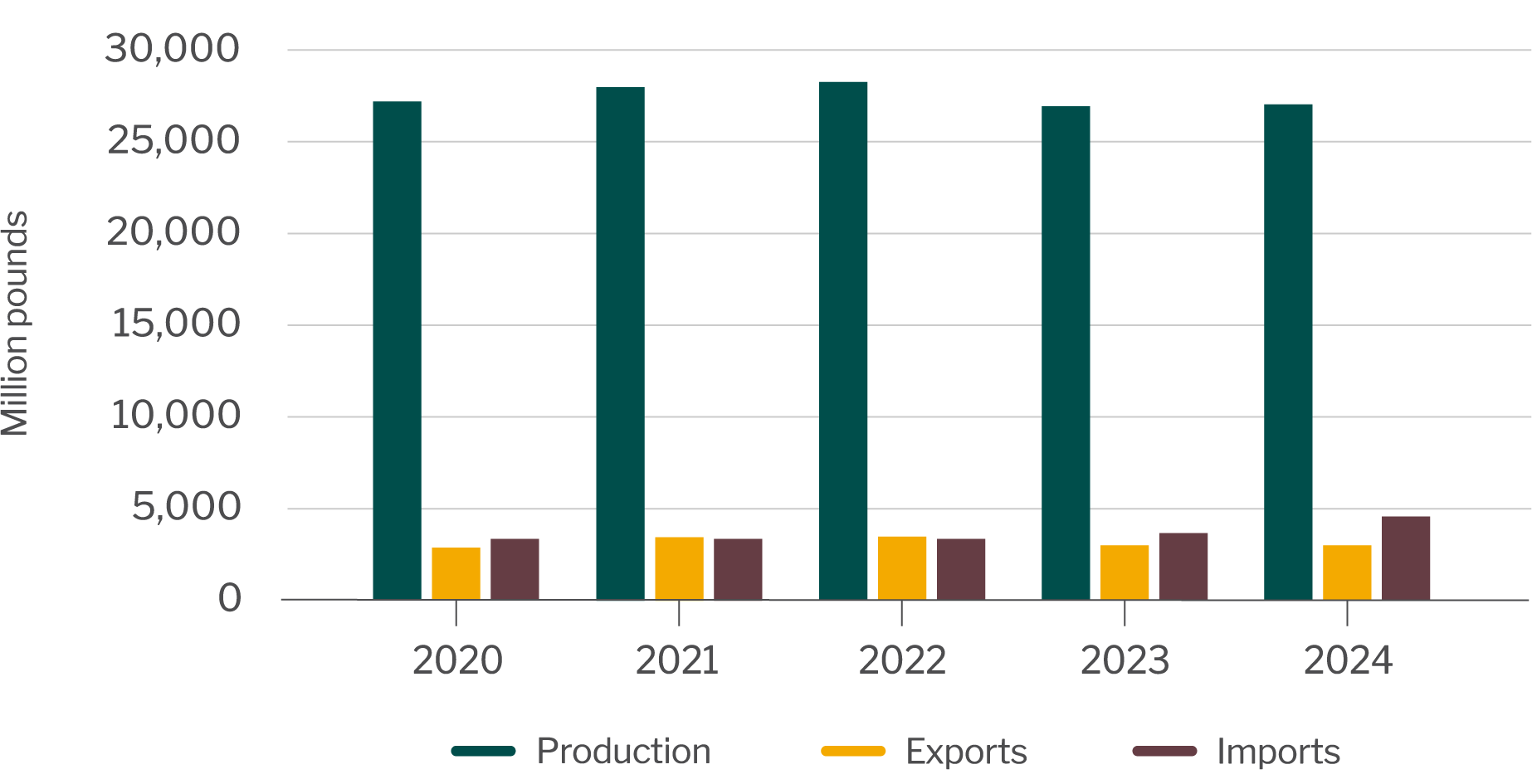
USDA Livestock and Meat International Trade Data.
Tariff tracker - Tariff rates applied to U.S. trade partners are consistenly updated to reflect policy changes. The World Trade Organization (WTO) tracks duties and tariffs on beef products and live cattle by country. For your convenience, the following links will take you to tariff data on fresh or chilled bovine meat (a leading U.S. export for the cattle industry) for top markets including South Korea and China. Beef products are currently exempt from tariffs for Mexico and Canada under the United States-Mexico-Canada Agreement (USMCA), but please refer to the U.S. Trade Representative website for up-to-date information. WTO also tracks rates for beef imports to the U.S. Please consult with a trade lawyer or professional for detailed and up-to-date insights on tariff rates and their application to cattle.
For guidance on interpreting duty and tariff rates, please refer to our Tariff Guide.
Cattle updates
Prices recede, but cattle fundamentals remain.
Cattle markets softened during August after reaching record highs earlier this summer. Recent policy developments coupled with a rebound in hay market prices have tempered producer optimism. Producers who marketed cattle earlier or locked in contracts at peak prices continue to benefit from historically strong margins, while those still holding cattle have seen prices ease. Fed cattle markets have softened since July. Calf values have also retreated by 15% from midsummer peaks, although they remain among the highest levels producers have ever received. Despite the recent correction, fundamentals remain supportive as cattle inventories stay historically tight and beef demand continues to hold up remarkably well, even with retail beef prices at record levels.
Feed and forage concerns are becoming a larger focus as producers plan for fall and winter. Across much of the West, deteriorating pasture conditions and earlier-than-normal range removal are forcing some operations to begin supplemental feeding sooner than usual. As of August 31, 59% of Arizona, 46% of Idaho, 55% of Montana, and 39% of Oregon pasture and rangeland was rated poor to very poor. At the same time, strengthening hay prices are increasing winter feed costs. Some producers were able to receive disaster assistance payments of $36 to $38 per head, which has helped offset a portion of rising feed and transportation expenses.
Processing capacity remains a concern for many cattle producers. Tyson Foods announced in August that it is seeking a buyer for its Wallula, Washington, beef processing facility. While the plant is expected to continue operating under new ownership, the announcement highlights broader industry concerns about long-term packing capacity and its potential impact on future herd expansion. At the same time, producers are closely monitoring recent federal policy developments. A September 4 executive order calls for reviews of federal grazing policies, wolf management, and mandatory country-of-origin labeling (COOL) authority for beef products.
Beef imports remain a focal point of politics, resulting in a series of shifting and sometimes inconsistent policy decisions that have added uncertainty to the cattle market. In August, the announcement of a 90-day tariff waiver allowing up to 300,000 metric tons of imported ground beef surprised many producers. While the U.S. typically imports 70,000 to 80,000 metric tons of lean beef trim per month, utilization of the full allocation would temporarily push imports well above normal levels. Although the additional volume is not expected to significantly alter overall beef supplies or materially reduce retail beef prices, many producers viewed the decision negatively given historically tight cattle inventories and strong producer profitability. This announcement came on the heels of a 30,000-pound recall of imported beef products, leading some producers to worry that consumer confidence and demand for beef products could be negatively impacted.

Profitability
September 16, 2026Cattle feeders: Slightly profitable - Bearish 12-month outlook
Cow-calf producers: Very profitable - Bearish 12-month outlook
Strong fed cattle prices continue to offset elevated feeder cattle costs, although narrowing margins and softer cattle prices have reduced profitability from earlier highs.
The outlook has turned more bearish over the next 12 months as calf prices have retreated from record highs and concerns grow over increased beef imports, higher feed costs, and growing uncertainty surrounding cattle prices and producer margins.
Exports play a key role in driving demand for U.S. beef, with 12% of production exported. Major export destinations include Japan, South Korea, China, Mexico and Canada. Exports also increase the value of beef byproducts, including variety meats (e.g., tongue, cheek meat, hearts) along with tallow and hides, which have limited demand domestically. The higher prices and increased sales of these items boost overall live cattle values and improve packers' margins.
Beef imports primarily consist of lean processing beef used in ground beef to meet domestic consumer demand. Over the past decade, U.S. imports of fresh or chilled beef have more than doubled. Given the tight domestic cattle supply, beef imports are important to meeting consumer demand for beef.
Beef production, exports and imports
USDA Livestock and Meat International Trade Data.
Tariff tracker - Tariff rates applied to U.S. trade partners are consistenly updated to reflect policy changes. The World Trade Organization (WTO) tracks duties and tariffs on beef products and live cattle by country. For your convenience, the following links will take you to tariff data on fresh or chilled bovine meat (a leading U.S. export for the cattle industry) for top markets including South Korea and China. Beef products are currently exempt from tariffs for Mexico and Canada under the United States-Mexico-Canada Agreement (USMCA), but please refer to the U.S. Trade Representative website for up-to-date information. WTO also tracks rates for beef imports to the U.S. Please consult with a trade lawyer or professional for detailed and up-to-date insights on tariff rates and their application to cattle.
For guidance on interpreting duty and tariff rates, please refer to our Tariff Guide.