Weather
 Locations
 Careers
 Login
Login


Apple updates
The 2026 apple crop appears to have good quality and to be smaller than the 2025 crop.
Harvest on early varieties for the 2026 apple crop, including Gala and Honeycrisp, has begun. Reports continue to suggest crop quality is favorable and production levels smaller than the previous season. Processing markets, which utilize lower quality fruit, are relatively strong and are increasing the price floor across varieties. USApple projects the 2026 U.S. crop to fall 7% year over year, with declines observed across all states including Washington (2%), New York (10%) and Michigan (1%). The federal district’s ruling on the Adverse Effective Wage Rate (AEWR) in the H-2A visa program could negatively impact apple producer profitability (see Crop Inputs for more information on the ruling). USApple is supporting a bill recently submitted to Congress, called Securing Agriculture’s Workforce Act, that would codify changes to the H-2A program such as limiting year-over-year increases in wage rates and accounting for housing and transportation costs provided by growers. It’s unclear how likely it is for this bill to be approved. Labor cost and availability remain among the top challenges producers face across the West.
Harvest on early varieties of the 2026 pear crop, including Bartletts, has begun. Reports suggest fruit quality is favorable and the size is notably smaller than the large 2025 crop. There is cautious optimism prices will begin to reflect these improved conditions. The 2026 cherry season appears to be positive overall. Following a mid-June supply glut, prices rebounded in time for the July 4th holiday, which generally correlates with peak seasonal demand. USDA forecasts sweet cherry production came in at about 31 million boxes, down 17% from 2025 levels and below the five-year average. Year-over-year declines were observed in Washington (23%), Oregon (24%) and Michigan (24%).
Profitability
September 16, 2026Apple producers: Slightly unprofitable - Bullish 12-month outlook
Apple packers: Slightly profitable - Neutral 12-month outlook
While the large 2025 crop continues to pressure profitability among producers, the 2026 crop looks to come in smaller and more in line with demand.
Apple packers continue to benefit from strong throughput volumes.
While the bulk of apples produced in the U.S. is sold domestically, export markets are relatively important and make up anywhere from 15% to 20% of total production. Foreign markets are particularly important for older varieties that have fallen out of fashion in the U.S., namely Red and Golden Delicious. Mexico, Canada, Taiwan, Vietnam and India are the largest foreign markets. While Washington has a reputation for producing superior-quality fruit, exports are sensitive to trade policy given significant production levels from competitors in Europe, China, Chile and South Africa. Between 2021 and 2024, U.S. apple exports to India fell to near-zero levels due to retaliatory tariffs. Apple imports make up a very small portion of the total domestic supply.
Apple production, exports and imports
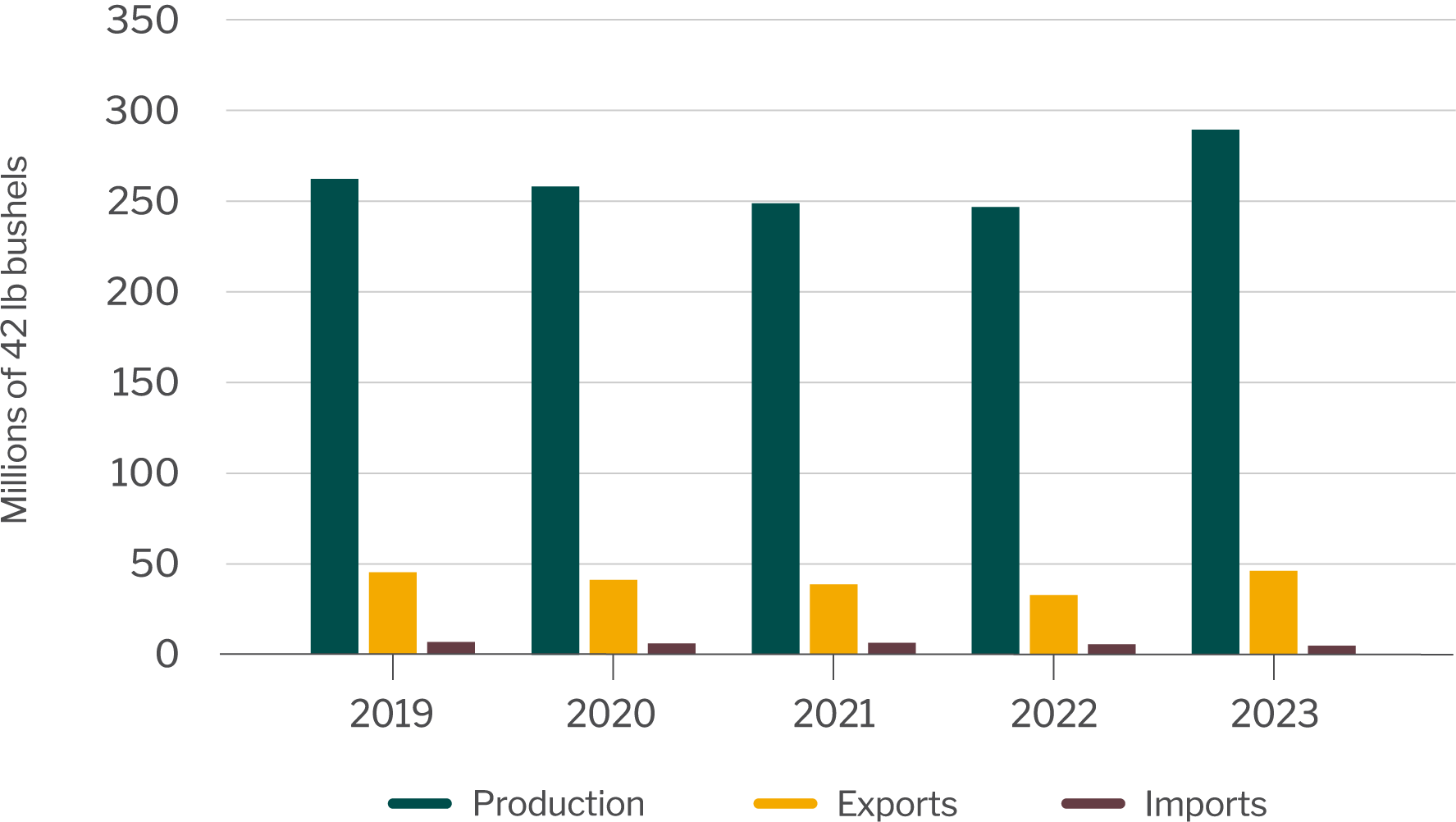
Source: USApple Outlook Reports.
Tariff tracker - Tariff rates applied to U.S. trade partners are consistenly updated to reflect policy changes. The World Trade Organization (WTO) tracks duties and tariffs on fresh apples. For your convenience, the following links will take you to tariff data for Vietnam and India. Apples are currently exempt from tariffs with Mexico and Canada under the United States-Mexico-Canada Agreement (USMCA), but please refer to the U.S. Trade Representative website for up-to-date information. WTO also tracks rates for apple imports to the U.S. Please consult with a trade lawyer or professional for detailed and up-to-date insights on tariff rates and their application to fresh apples.
For guidance on interpreting duty and tariff rates, please refer our Tariff Guide.
Apple updates
The 2026 apple crop appears to have good quality and to be smaller than the 2025 crop.
Harvest on early varieties for the 2026 apple crop, including Gala and Honeycrisp, has begun. Reports continue to suggest crop quality is favorable and production levels smaller than the previous season. Processing markets, which utilize lower quality fruit, are relatively strong and are increasing the price floor across varieties. USApple projects the 2026 U.S. crop to fall 7% year over year, with declines observed across all states including Washington (2%), New York (10%) and Michigan (1%). The federal district’s ruling on the Adverse Effective Wage Rate (AEWR) in the H-2A visa program could negatively impact apple producer profitability (see Crop Inputs for more information on the ruling). USApple is supporting a bill recently submitted to Congress, called Securing Agriculture’s Workforce Act, that would codify changes to the H-2A program such as limiting year-over-year increases in wage rates and accounting for housing and transportation costs provided by growers. It’s unclear how likely it is for this bill to be approved. Labor cost and availability remain among the top challenges producers face across the West.
Harvest on early varieties of the 2026 pear crop, including Bartletts, has begun. Reports suggest fruit quality is favorable and the size is notably smaller than the large 2025 crop. There is cautious optimism prices will begin to reflect these improved conditions. The 2026 cherry season appears to be positive overall. Following a mid-June supply glut, prices rebounded in time for the July 4th holiday, which generally correlates with peak seasonal demand. USDA forecasts sweet cherry production came in at about 31 million boxes, down 17% from 2025 levels and below the five-year average. Year-over-year declines were observed in Washington (23%), Oregon (24%) and Michigan (24%).

Profitability
September 16, 2026Apple producers: Slightly unprofitable - Bullish 12-month outlook
Apple packers: Slightly profitable - Neutral 12-month outlook
While the large 2025 crop continues to pressure profitability among producers, the 2026 crop looks to come in smaller and more in line with demand.
Apple packers continue to benefit from strong throughput volumes.
While the bulk of apples produced in the U.S. is sold domestically, export markets are relatively important and make up anywhere from 15% to 20% of total production. Foreign markets are particularly important for older varieties that have fallen out of fashion in the U.S., namely Red and Golden Delicious. Mexico, Canada, Taiwan, Vietnam and India are the largest foreign markets. While Washington has a reputation for producing superior-quality fruit, exports are sensitive to trade policy given significant production levels from competitors in Europe, China, Chile and South Africa. Between 2021 and 2024, U.S. apple exports to India fell to near-zero levels due to retaliatory tariffs. Apple imports make up a very small portion of the total domestic supply.
Apple production, exports and imports
Source: USApple Outlook Reports.
Tariff tracker - Tariff rates applied to U.S. trade partners are consistenly updated to reflect policy changes. The World Trade Organization (WTO) tracks duties and tariffs on fresh apples. For your convenience, the following links will take you to tariff data for Vietnam and India. Apples are currently exempt from tariffs with Mexico and Canada under the United States-Mexico-Canada Agreement (USMCA), but please refer to the U.S. Trade Representative website for up-to-date information. WTO also tracks rates for apple imports to the U.S. Please consult with a trade lawyer or professional for detailed and up-to-date insights on tariff rates and their application to fresh apples.
For guidance on interpreting duty and tariff rates, please refer our Tariff Guide.