 Weather
 Locations
 Careers
 Login
Login


Wine grape updates
Wine grape harvest is coming on early with below average yields.
The wine market remains under pressure as U.S. wine sales declined year over year approximately 3.0% by value and 4.7% by volume through late mid-July, driven by weak demand and excess inventories. Industry participants increasingly focused on whether the market is approaching a bottom, with some reporting improved inventory movement and stronger performance in categories such as Sauvignon Blanc, aromatic whites, sparkling wine, and premium wines. Consolidation and restructuring remained key themes during the month, highlighted by portfolio acquisitions, distributor realignments, and continued efforts by wineries to reduce costs, improve profitability, and adapt to a smaller market.
Wine grape harvest is underway across the West Coast, with California experiencing one of its earliest harvests in decades and the Columbia Valley running about a week ahead of its long-term average. While crop quality appears favorable, yields are generally coming in below average after spring weather disrupted fruit set during bloom. Combined with recent vineyard removals and lower-input vineyard management, the 2026 crop is estimated to be smaller than recent years. Given ongoing oversupply concerns, many view the lighter harvest as a step toward rebalancing the market, though industry participants generally expect it could take a year or more before supply and demand return to a more sustainable balance. Overall, wildfire activity appears to have had minimal impact on grape quality, though some smoke impact has been observed in the North Coast region of California.
Profitability
September 16, 2026Wine: Slightly unprofitable - Neutral 12-month outlook
Wine grapes: Unprofitable - Neutral 12-month outlook
Wine demand continues to soften and pressure the industry, particularly in the lower- to mid-range segments.
Weak demand and excess bulk wine inventories continue to pressure wine grape producers.
The U.S. is the fourth largest New World (non-European) producer globally, it is the largest consumer, importing a third of its domestic supply. Key foreign suppliers include Italy, Canada, France, Australia, Chile and New Zealand. The U.S. exports 8% of its production, with about 50% split between the United Kingdom and Canada.
Wine production, exports and imports
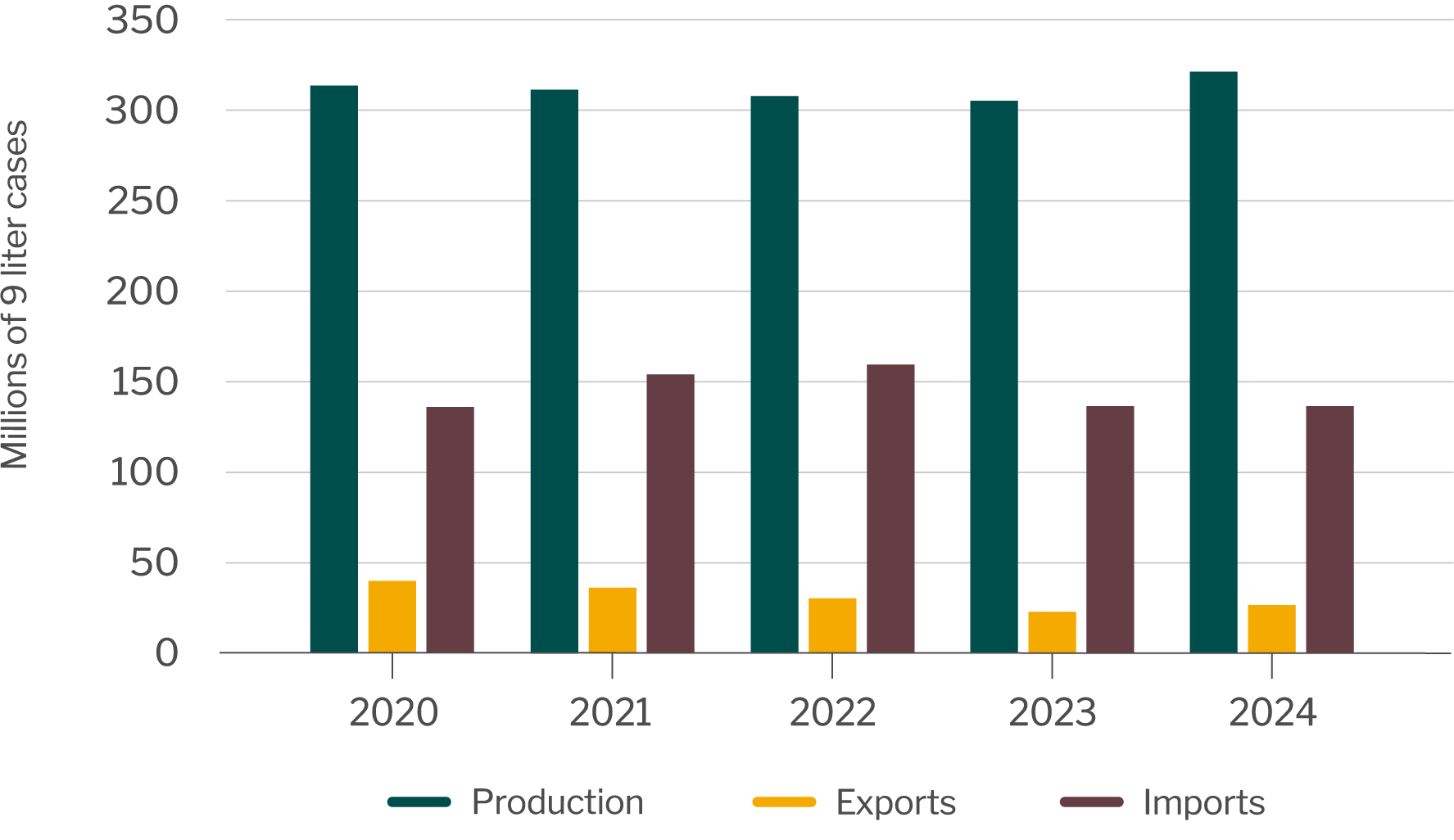
Source: Wine Institute. U.S. Census Bureau.
Tariff tracker - Tariff rates applied to U.S. trade partners are consistenly updated to reflect policy changes. The World Trade Organization (WTO) tracks duties and tariffs on wine. For your convenience, the following link will take you to tariff data for the United Kingdom. Wine is currently exempt from tariffs for Canada under the United States-Mexico-Canada Agreement (USMCA), but please refer to the U.S. Trade Representative website for up-to-date information. WTO also tracks rates for wine imports to the U.S. Please consult with a trade lawyer or professional for detailed and up-to-date insights on tariff rates and their application to wine.
For guidance on interpreting duty and tariff rates, please refer to our Tariff Guide.
Wine grape updates
Wine grape harvest is coming on early with below average yields.
The wine market remains under pressure as U.S. wine sales declined year over year approximately 3.0% by value and 4.7% by volume through late mid-July, driven by weak demand and excess inventories. Industry participants increasingly focused on whether the market is approaching a bottom, with some reporting improved inventory movement and stronger performance in categories such as Sauvignon Blanc, aromatic whites, sparkling wine, and premium wines. Consolidation and restructuring remained key themes during the month, highlighted by portfolio acquisitions, distributor realignments, and continued efforts by wineries to reduce costs, improve profitability, and adapt to a smaller market.
Wine grape harvest is underway across the West Coast, with California experiencing one of its earliest harvests in decades and the Columbia Valley running about a week ahead of its long-term average. While crop quality appears favorable, yields are generally coming in below average after spring weather disrupted fruit set during bloom. Combined with recent vineyard removals and lower-input vineyard management, the 2026 crop is estimated to be smaller than recent years. Given ongoing oversupply concerns, many view the lighter harvest as a step toward rebalancing the market, though industry participants generally expect it could take a year or more before supply and demand return to a more sustainable balance. Overall, wildfire activity appears to have had minimal impact on grape quality, though some smoke impact has been observed in the North Coast region of California.

Profitability
September 16, 2026Wine: Slightly unprofitable - Neutral 12-month outlook
Wine grapes: Unprofitable - Neutral 12-month outlook
Wine demand continues to soften and pressure the industry, particularly in the lower- to mid-range segments.
Weak demand and excess bulk wine inventories continue to pressure wine grape producers.
The U.S. is the fourth largest New World (non-European) producer globally, it is the largest consumer, importing a third of its domestic supply. Key foreign suppliers include Italy, Canada, France, Australia, Chile and New Zealand. The U.S. exports 8% of its production, with about 50% split between the United Kingdom and Canada.
Wine production, exports and imports
Source: Wine Institute. U.S. Census Bureau.
Tariff tracker - Tariff rates applied to U.S. trade partners are consistenly updated to reflect policy changes. The World Trade Organization (WTO) tracks duties and tariffs on wine. For your convenience, the following link will take you to tariff data for the United Kingdom. Wine is currently exempt from tariffs for Canada under the United States-Mexico-Canada Agreement (USMCA), but please refer to the U.S. Trade Representative website for up-to-date information. WTO also tracks rates for wine imports to the U.S. Please consult with a trade lawyer or professional for detailed and up-to-date insights on tariff rates and their application to wine.
For guidance on interpreting duty and tariff rates, please refer to our Tariff Guide.
IN THIS SECTION


Wine/Vineyard Industry Perspective
View the latest AgWest Wine/Vineyard Industry Perspective
Learn more